Topic 9. New Spain
Introduction

In this topic, you are going to learn about people in the New Spain and the Spaniards merge to create new culture and art. It is important to notice that many things that you are going to see in this topic are still relevant nowadays: sculptures and buildings that exist today, strong issues like discrimination that remain, problematic and easily artistic styles and manifestations that you can see at your own city. This topic, will also help you to understand more about yourselves and your past.
Explanation:
9.1 Culture Shock
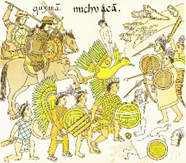 The blending between Spanish people, the vast and diverse people from Mexico, Guatemala and Peru was not easy. In the first place, there was the issue of the identity. How do the conquered people could identify, if they got imposed a new religion, a new organization, a new everything? Would they just start to learn another language or they would try to remain their beliefs? According to Anthony King, quoted by Lina Bondi (2011), identity is mostly related to places, therefore, architecture (which we would see in the next topic) was one of the solutions of this identity problem:
Identity is frequently related to geographical location and a specific sense of place, a place which may be characterized by a distinctive climate, and particular geographical, cultural, linguistic, architectural, social, and other characteristics. Notions of identity also rely on memory -of a shared past, a particular place- and the creation, and retention, of a coherent symbolic repertoire of signs (Lina Bondi, 2011).
In a quote from Anthony King, there are many elements addressed that impact the identity. Many things would change in the New Spain and one of them was the system of caste, or castas. Castas is another word to call the race or the blood lineage of someone. As people from Spain started having children with Indians, soon there were some classifications in order to identify the people that were not mixed with Indians and the one who were. Let’s look at some of the different castes, according to Roberta Jestes (2013):
- Peninsulares (Spaniards): Persons of Spanish descent born in Spain. Some of them were working in important places, for example, in the Church, the army or the government.
- Criollos (Spanish Americans): A black or white person born in the Americas but non-indigenous, of a Spanish descent.
- Indios (Amerindians): The original people of the Americas, considered a pure race.
- Mestizos (Amerindian and Spanish mix): One parent was Spanish, the other parent was Amerindian.
- Castizos (Spanish with some Amerindian mix): One of the parent was Mestizo and the other was Spanish.
- Cholos (Amerindian with some Spanish mix): Persons with one Amerindian parent and one Mestizo parent.
- Mulattos (African and Spanish mix): Persons of a Spanish parent and an African parent. They were born in slavery.
- Zambos (Amerindian and African mix): Persons that come from a mix of Amerindian and Black.
- Pardos (Spanish, African, and Amerindian mix): Persons that can come in a relation of a Spaniard with a Zambo, a Mulatto with a Mestizo or an African with a Mestizo.
As you can see, this classification would redefine entirely the relation among people, even some of them could not do certain activities (as work or be a free person) just because of this classification. Years later, the priest Miguel Hidalgo y Costilla would start the Independence movement of México. Hidalgo himself was a criollo and he knew that he had fewer rights than others, the search for equality was one of many reasons for him to start the movement.
9.2 Baroque in America
The Catholic Church started expanding all over the New Spain and their influence was noticeable. During the expansion many documents and idols were destroyed, that could have helped us understand our past and our culture, and documents that helped them make an alphabet (that’s why the Nahuatl or Aztec language is written with Latin letters because the friars thought them the Latin alphabet). Some of them wrote books about the things they saw and we have information from that time thanks to those works.
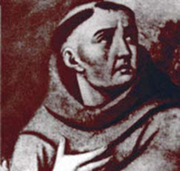 |
Fray Toribio de Benavente, “Motolinia”. Image retrieved from http://goo.gl/kUAAst For educational purpose only. |
Even if there was great influence from Spain, people in New Spain could somehow preserve their culture, making a syncretism between New Spain and Spain. People needed to rework their identity, because the things they believed and had done for a long time started to change. One of the most important things to define identity is the architecture: the presentation of our surroundings, colors, shapes, and forms, changes our perspective:
Architecture plays a particularly important role in the construction and representation of cultural identity, as the way in which its inhabitants experience and interpret their surroundings is translated into the built environment. Architects Mark Olweny and Jacqueline Wadulo demonstrates the relationship between architecture and society, stating that: “architecture serves an important purpose in the non-verbal communication of cultural values and aspirations of a community or in some cases of the ruling” (Lina Bondi, 2011).
The influence of one of the most important cultural movements from Europe, and, more specific, in Spain: the Baroque art became an icon in New Spain. The Baroque art had some unique and distinctive characteristics that made them very recognizable (México Desconocido, 2014):
- Its peak was in the XVII century, when the conquest of Spain was already settled and people could focus on art and culture.
- Architecture, painting, music, and literature were the most important art.
- Other minors or not so popular arts, like ceramic and silverware, also flourish in those times.
- There was an abandonment of the Greek and Latin influence in the buildings.
- Religious artworks, with ecclesiastic tones, were the ones that prevalence in the paintings.
- Music was also created for the Church.
- In literature the most important writer from the New Spain, Sister Juana Ines de la Cruz, emerged.
Some of the buildings that represents the influence of the Baroque in the New Spain are cathedrals. The Baroque architecture in the New Spain seems to be more important than in Spain. One of the most important cathedrals is the one in Mexico City: the Metropolitan Cathedral.
It was constructed where the temple of Tenochtitlan was. Hernán Cortés put the first stone for the construction, also as a symbolic act to establish that the new order and power were the Spaniards. The cathedral was finished until 1813.
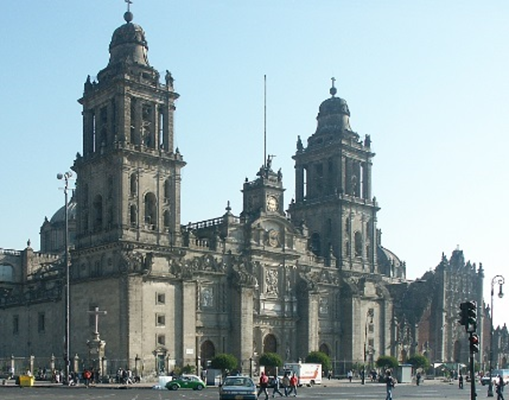
Metropolitan Cathedral
Image retrieved from http://www.bluffton.edu/~sullivanm/mexico/mexicocity/cathedral/1.jpg
For educational purpose only.
In the interior it has murals from two very important painters of the New Spain: Juan Correa and Cristóbal de Villalpando (Ciudad de México, 2009). One of Juan Correa best paintings is considered to be the "Assumption of the Virgin" (1685-1686) and the Virgin of Guadalupe, here is a general description (Exploring Colonial Mexico, n.d.):
A common feature of the Guadalupana icon from the earliest times, as is seen in the Correa painting, was the inclusion of subsidiary scenes of the four apparitions, here placed in the corner ovals. At the top, these illustrate Juan Diego's first meeting with the Virgin on the way to church, and his second encounter, accompanied by angels. Below, Juan Diego kneels before the Virgin at his third meeting when she proffers him a bouquet of roses — in itself a miraculous event since roses did not bloom at that time of year. Finally, Archbishop Zumarraga is shown on his knees worshipping the image on the tilma held up by Juan Diego.
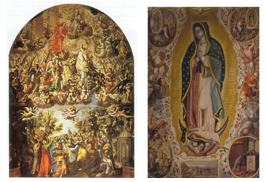
Assumption of the Virgin / Guadalupana by Juan Correa.
Image retrieved from http://goo.gl/nwKGuk y http://goo.gl/tQD7Ru
For educational purposes only.
Without these representations, images and iconography, the influence of the Church and the adoration of the Virgin of Guadalupe may not be as important as it is nowadays. Architecture influences us and creates a certain perspective in our minds, in the way we see the world.
Returning to the description of the cathedral, since it was constructed throughout different centuries it is normal to see very different styles. Some of the influences of the Renaissance period, the Baroque period and the Neoclassicism period.
During that period, the Churrigueresque style emerged, characterized by its elaborate ornamentation. This style is marked by an abundance of decorative elements, including broken pediments, undulating cornices, reversed volutes, balustrades, stucco shells, and garlands, all designed to create an overwhelming visual experience. While the term "Churrigueresque" originates from the architect José Benito Churriguera, he is not the definitive representative of this style. It's important to distinguish that in the context of New Spain, specific terms such as "anastyle baroque," "niche pilaster," or "dissolvent baroque" better describe the local variations of Baroque architecture, reflecting the unique characteristics and historical context of the region.
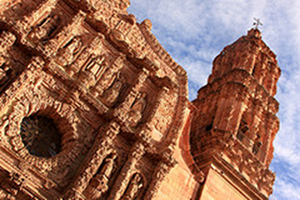
Churrigueresque style in Zacatecas.
Image retrieved from http://goo.gl/mjufZ2
For educational purposes only.
Painting in this period was mainly about religion. You can find one of the first murals that show the arrival of Franciscans in 1524 in Puebla, at the Convent of Huejotzingo (Mexican Art Info, 2014).
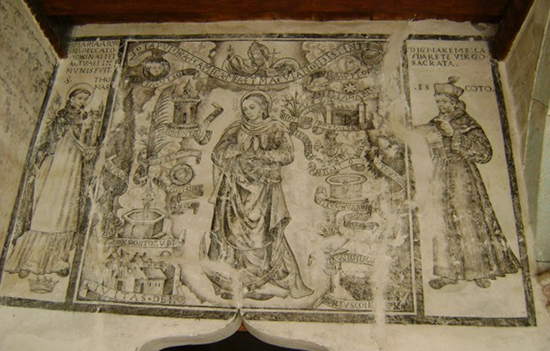
Convent of Huejotzingo
Image retrieved from http://goo.gl/vtL95v
For educational purposes only.
An interesting case of paintings representing the Castas social system, commonly includes a woman and a man with a child, explaining the race of every one of them in the painting. For example, if a Spanish man and an Indian woman had a child, the child would be a mestizo. A mestizo man with a Spanish woman would be called a castizo. There were many denominations for race mixture and some of them were heavily discriminated because of that.
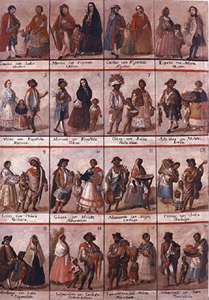
Castas paintings
Image retrieved from http://goo.gl/FKkIOB
For educational purposes only.
However, there was another use for this kind of paintings, according to Annenberg Learner (2014) paintings: have sometimes been interpreted as souvenirs for Spanish audiences. The inclusion of local foodstuffs, flora, and fauna in many of these images suggests that they were celebrations of colonial prosperity”. Other theories believe that this kind of images were created because of the Enlightenment period in Europe, where everything wanted to be classified for their study. Nevertheless, note how the problem of the discrimination is very old, because just for the color of their skin or for who were their parents, they decided to treat people in different manners. Unfortunately, this kind of attitudes still continues nowadays.
It is important to talk about the literature work of one of the most influential writers in the New Spain and in Mexico, even nowadays: sister Juana Inés de la Cruz (Joan Agnes of the Cross, 1651-1695).
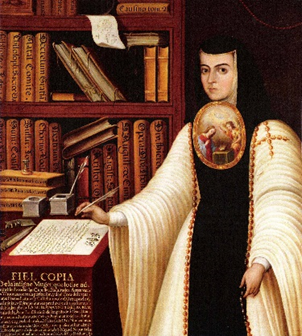
Sister Juana Ines de la Cruz.
Image retrieved from http://goo.gl/NlBH1d
For educational purpose only.
Some of the most famous stories about her are that she started reading at the age of three and, years later, she asked her mom to dress her like a man in order to study at a University in Mexico City. Another story told is that many intelligent men like theologians and philosophers asked her about various difficult subjects and she could answer every question made at her. Being a religious woman seem to be the only option to continue her studies.
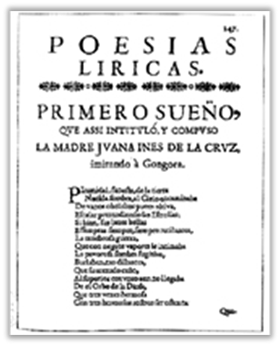
“The Dream”, by Sister Juana Inés de la Cruz.
Image retrieved from http://goo.gl/NRKi4V
For educational purposes only.
Sister Juana wrote plays, poems, and essays. One of the most important poems written in Spanish is The Dream or First Dream (Primer Sueño) in which she express her thoughts about God, the soul, the body and many things in a philosophical and complicated way. On the other hand, she also wrote other poems that were very popular for their jocose content and their easy rhyme. Look at the first two stanzas of the poem You Men, a critique of the dominance and incoherence of the male gaze, written from the perspective of a woman.
Silly, you men-so very adept
at wrongly faulting womankind,
not seeing you're alone to blame
for faults you plant in woman's mind.
After you've won by urgent plea
the right to tarnish her good name,
you still expect her to behave--
you, that coaxed her into shame.
(De la Cruz, 2014).
Feminism did not exist as a movement at the time; however, Sister Juana Inés de la Cruz would be considered a watershed: a well-educated woman, capable of criticizing important people and with intelligence. Of course, not everybody was happy with this and, at 1693, she was forced to stop writing, she sold her books and all her belongings, in order to live like a Sister of the Church. She died at 1695 because of a plague that invaded the San Jeronimo Convent, where she lived.
9.3 Neoclassicism in America
One of the most important architects in this period was the Spaniard Manuel Tolsá (1757-1817). He was responsible for introducing the Neoclassicism to the New Spain.
Neoclassicism tried to return to the classic forms of the Greeks and Latins, with a relaxed sense of order and proportion, instead of the exaggerated ways of Baroque. According to the Encyclopaedia Britannica (2014), Tolsá worked in the cathedral of Mexico (hence, the Neoclassical influence of it), finishing the cupola. He also created three sculptures from Faith, Hope and Charity that are at the top of the facade.
The Palace of Mines (in Spanish: Palacio de Minería) is a building designed and created by Manuel Tolsá. This place is used nowadays as the School of Engineering from the National Autonomous University of Mexico (UNAM). This place is a masterpiece of Latin American neoclassicism and a majestic monument of elegant forms and exact proportions where light, space and functionality merge, is one of the most outstanding constructions within Mexican architecture (Facultad de Ingeniería, 2010).
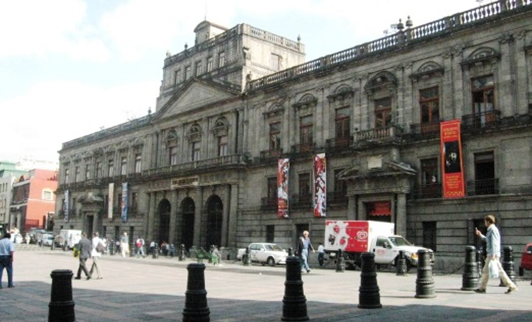
The Palace of Mines.
Image retrieved from http://goo.gl/T8FUPO
For educational purposes only.
Near the Palace of Mines, you can find an equestrian statue of Charles IV, nicknamed as El Caballito (English: Small Horse), also made by Tolsá. It depicts him as a Roman Emperor, sitting on a horse. The sculpture measures 5.04 meters large and 4.88 meters height and weighs 20 tons (Facultad de Ingeniería, 2010). It can be seen today at the Plaza Manuel Tolsá, at the Historic Center of Mexico City.
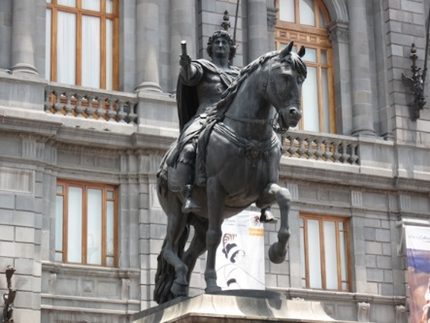
El Caballito
Image retrieved from http://goo.gl/DqhJjt
For educational purposes only.
Conclusion:
In this topic, you learned that Mexican culture is a civilization that has been influenced by many things: the conquest, the indigenous past, Spanish people, Baroque, Neoclassicism, as well as many other things. It is sad to look how people of New Spain were discriminated, and this kind of things also happen nowadays in Mexico, where there is discrimination against indigenous people.
Bibliographic references:
- Annenberg Learner. (2104). Human Races (Las Castas). Retrieved from http://www.learner.org/courses/globalart/work/85/
- Ciudad México (2009). Catedral Metropolitana de la Ciudad de México. Retrieved from http://www.ciudadmexico.com.mx/atractivos/catedral.htm
- de la Cruz, S.J.I. (2014). You Men. Poem Hunter. Retrieved from http://www.poemhunter.com/poem/you-men/
- Encyclopaedia Britannica (2014). Chirrigueresque. Retrieved from http://global.britannica.com/EBchecked/topic/117383/Churrigueresque
- Encyclopaedia Britannica (2014). Manuel Tolsá. Retrieved from http://global.britannica.com/EBchecked/topic/598688/Manuel-Tolsa
- Exploring Colonial Mexico (n.d.). The Virgin of Guadalupe, a painting by the colonial artist Juan Correa. Retrieved from http://goo.gl/iSNuXh
- Facultad de Ingeniería (2010). 2. Estatua Ecuestre de Carlos IV. Palacio de Minería, Universidad Autónoma de México. Retrieved from http://goo.gl/K3p2Yl
- Facultad de Ingeniería (2010). Palace of Mines. Palacio de Minería, Universidad Autónoma de México. Retrieved from http://goo.gl/FCBxTK
- Jestes, R. (2013). Las Castas - Spanish Racial Classification. Native Heritage Project. Retrieved from http://goo.gl/XJauNo
- Lina Bondi, C.M. (2011). Shaping an Identity: Cultural Hybridity in Mexican Baroque Architecture. Design Principles and Practices. An International Journal. Volume 5, Issue 5. Retrieved from https://www.academia.edu/1486797/Shaping_an_Identity_Cultural_Hybridity_in_Mexican_Baroque_Architecture
- Mexican Art Info (2014). The Colonial Period. Retrieved from http://mexicanart.info/colonial.htm
- México Desconocido (2014). Arte y cultura en la Colonia. Retrieved from http://www.mexicodesconocido.com.mx/arte-y-cultura-en-la-colonia.html
- Profesor en línea (2014). Arte y cultura colonial en México. Retrieved from http://www.profesorenlinea.cl/Paisesmundo/Mexico/Mexico_Arte_Cultura_Colonial.html

Checkpoint
Make sure you understand:
- The different castes from the New Spain.
- The elements of architect and sculpture from Manuel Tolsá.