Topic 10. Baroque
Introduction

Maybe in the description of a building, or when someone looks at something very detailed, the term baroque brought your attention. At the beginning, this word was used in a pejorative way. Something very detailed was not the focus of the paintings from this era, so, artworks with those characteristics used to be called that way. A baroque pearl or gem was an irregular one, usually meaning something out of proportion or without balance. Something that started like an insult evolved and influenced a complete period.
There are not specific dates, but it is considered that the Baroque started and was developed in the 16th century and ended at the beginning of the 17th century, but it varies depending on the country. As you can remember, one of the characteristics of the Renaissance we talk about was anthropocentrism, the idea that everything revolves around the human being, which leads to philosophical and ideological movements such as Humanism.
Click to see an example.
According to Jackson (2014), the Catholic Church was very powerful in the 16th century, but also very corrupt. Martin Luther, a catholic priest, started questioning the Catholic Church about the idea of the indulgences, in which normal people paid money to the Church to obtain the forgiveness for their sins, the money obtained were supposed to be for rebuilding the St. Peter’s Basilica in Rome. Because of that, a new church was created: Protestantism, which protested against the luxury of the Catholic Church. The answer from the Catholic Church was the Counter-Reformation, a movement that intended to stop the Protestant Church, and banned the selling of indulgences. In addition, in England, in 1534, King Henry VIII, wanting the divorce from his wife, created the Church of England.
The absolute monarchy was in vogue. “The 17th century is known as the Age of Absolutism because of certain rulers who tried to exercise absolute power over their countries. According to the principle of divine right of kings, rulers derived their authority directly from God” (Schneider, 2007).
As explained by Schneider (2007), even when religious tension was about to explode and many people were being accused from heresy and witchcraft, science was a gaining force, because scientists started observing that natural phenomenon could be predictable. Nicolaus Copernicus said that the sun was the center of the universe and not the earth, Johan Kepler confirmed that the planets revolve around the sun in elliptical movements and Galileo Galilei conducted an experiment on gravity that proved that all bodies fall at the same speed. All of these scientific advances contradicted a lot of the thinking of the Catholic Church, so they censored and made Galileo declare that he was wrong. There, he said (but it has never been confirmed) one of the most famous phrases upon history: Eppur si muove, (English: And yet, it moves), meaning that, even if Church believes something, there was evidence that could support what he had said.
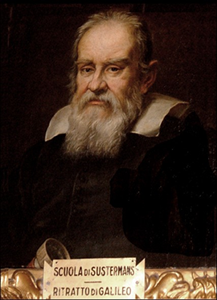
Galileo Galilei
Image retrieved from http://goo.gl/Q9Rl8k
For educational purposes only.
Before looking at some direct examples of the Baroque period, look at the following characteristics (McKay & McKay 2010; Sullivan 1994):
- It reacts against the Renaissance.
- • The images depicted are direct and obvious (there are less space for allegories or metaphors, although sometimes allegories are used, like in Vermeer’s The Art of Painting).
- Everything is exaggerated and with a lot of ornamentation.
- The characters portrayed seem to be like in the middle of an action: usually, images transmit a sense of movement.
- The viewer is invited to participate in the scene. Sometimes characters are looking directly to the spectator.
- The emotions portrayed are intense.
- The settings are extravagant.
- The artists do not search for the balance or equilibrium in their works.
- The use of contrast with dark and light is very popular.
- People portrayed seem to be real, not only perfect models with idealized beauty.
- In Baroque art, figures inundate the work of art, forcing the spectator to look at different points.
- Religious scenes were intense, for example, miracles or scenes of ecstasies. There are paintings of Jesus being punished and Saint Peter’s crucifixion.
- Psychology was important in this movement, characters seem to be affected by what is happening in the work of art.
This is the opposite from Renaissance, so it doesn’t include anything that looked like that movement. From clarity and illuminated tone to dark images.
Explanation:
10.1 Architecture
Some of the most intriguing architects of the time were Francesco Borromini, Gian Lorenzo Bernini (we are going to feature some of his sculptures later in this topic) and Guarino Guarini. Let’s examine an architectonic piece of each one.
Click to see an example.
 San Carlo alle Quatro Fontane by Francesco Borromin
According to the Saylor Foundation Academy (2014), this was the first commission from Borromini. It was shaped like a mixture of a cross, a rectangle and an oval, creating a strange form but also could be used to have a central-plan and a basilica. The interior is both traditional and innovative. Its walls, for example, are adorned with classical columns, but they curve around in a way that suggests movement, an effect that was progressive on that time. Likewise, the facade includes elements of classical architecture and applies them in a new and innovative way. There is the idea of movement that we would see a lot in the Baroque period.
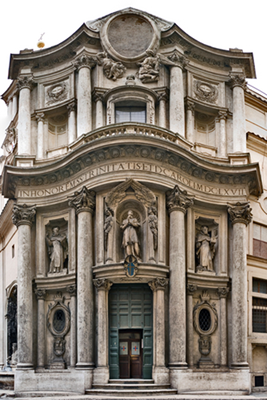
San Carlo Alle Quattro Fontane
Image retrieved from http://goo.gl/WjiIU2
For educational purposes only.
 Piazza of St. Peter by Gian Lorenzo Bernini
The description of this piazza is simply overwhelming:
Bernini conceived the piazza as an enormous oval framed by two colonnades of 284 columns and 88 pillars in four rows. Topped by an entablature with 140 statues of saints, the curved colonnades embrace a 650-foot-long oval like the motherly arms of the church, as Bernini said (Buffalo Architecture and History, 2002).
The open space would also function for the people that would go to see the Pope: there is a lot of space there, in order to listen to the mass and receive the official blessing, according to Norwich (2013).
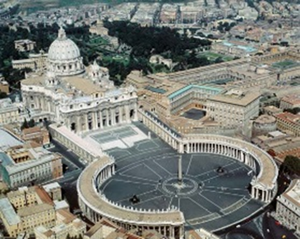
Piazza of St. Peter
Image retrieved from http://goo.gl/D0n1cx
For educational purposes only.
 Palazzo Carignano - Guarino Guarini
This palazzo is located in Turin, Italy. It is a museum nowadays, but it was originally the house of the Carignano family. The facade is very original, built in a curvilinear way and an elliptical central body, as described by Visita Torino (2013):
From the vestibule, two curvilinear staircases lead to the noble floor, where the party room was situated and transformed into the Sub Alpine Parliament in 1848. The palace was doubled in size from the interior side with the creation of the 19th century wing by Giuseppe Bollati on a drawing by Gaetano Ferri (1864-1871), with a heavy facade towards piazza Carlo Alberto, lying behind.
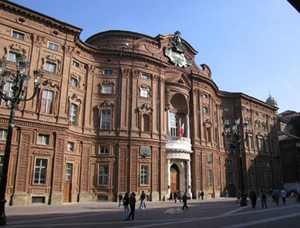
Palazzo Carignano.
Image retrieved from http://goo.gl/kcuXVd
For educational purposes only.
10.2 Painting
A characteristic especially important in painting is that there is no central figure to look at. For example, in The School of Athens by Raphael, look at the figures in the middle and you can identify them as Plato and Aristotle almost immediately. For their positions, they stand out of the picture. Something similar happens at The Last Supper by Leonardo da Vinci: the central figure is the most important: Jesus Christ. The lines in the painting point at Jesus, making him the focal point. However, in Baroque paintings, it does not exist that dynamic: any particular point captures the attention and that was one of the goals of the artist, fill with details that overwhelm and amaze. Look at some of the most important examples from various painters from the era to identify these characteristics.
The Maids of Honour by Diego Velázquez (Las Meninas).
Diego Velázquez was a Spanish painter (the official one for the court) who used a lot of psychological games in his paintings, involving the spectator to be part of his art. In this painting, you can see a scene from the court, there is a princess, her maids of honor, the king and the queen, a lady dwarf, a dog and Diego Velázquez himself painting something (but you can’t see what it is).
Velázquez, in the painting, is looking right to the front, as if he were painting the viewer: but looking at the composition, you could assume he is portraying the king and queen that appear reflected in a mirror. Surrounding the room, at the walls, there are also some paintings. Light is coming from the back (there is an open door, with a man, identified as José de Nieto, leaving), but also from the right side of the painting. Although the princess is the focal point, there are many things to look at. According to Rivera (2014), the painting can have three different centers: “La Infanta at the center of the foreground, the vanishing point right above Nieto’s elbow [...] and the mirror (as a compositional device). Depending on which center the viewer chooses to focus, views on the Monarchs’ presence shift” (Rivera, 2014). The Maids of Honour is a complex painting that can be viewed in different perspectives, perfect to summarize the goals of the Baroque style”.
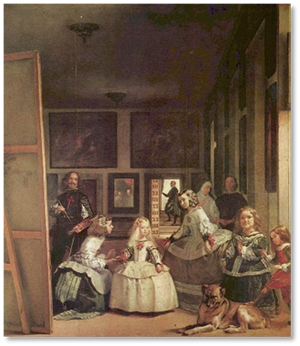
The Maids of Honour by Diego Velázquez
Image retrieved from http://goo.gl/NOHQVm
For educational purposes only.
The Crucifixion of St. Peter by Caravaggio.
In 1601 Caravaggio painted The Crucifixion of St. Peter for the church of Santa Maria del Popolo. The position of the characters in the painting is quite strange, with movements that you have not seen before. “Three shady characters, their faces hidden or turned away, are pulling, dragging and pushing the cross to which Peter has been nailed by the feet with his head down” (Boston College, 2014). According to the Christian tradition, Saint Peter was crucified but he decided to not being crucified like his master Jesus, but with his head down to the earth. The only face that you can see in the painting is the one of Peter: his facial expressions show the suffering and agony of the moment. Peter is not portrayed as a heroic character: he is just a human being in constant pain.
It is important to note that Caravaggio used a technique called tenebrism, that is, the use of extreme contrasts of light and dark in figurative compositions to heighten their dramatic effect; the term comes from the Latin tenebrae, darkness. In tenebrist paintings the figures are often portrayed against a background of intense darkness, but the figures themselves are illuminated by a bright, searching light that sets off their three-dimensional forms by a harsh but exquisitely controlled chiaroscuro (Encyclopaedia Britannica, 2014).
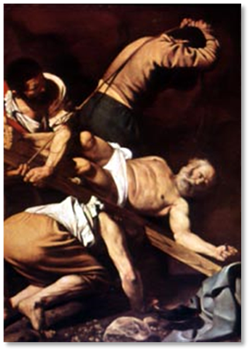
“The Crucifixion of St. Peter” by Caravaggio
Image retrieved from http://goo.gl/x4Hwfx
For educational purposes only.
The Art of Painting by Johannes Vermeer.
Just as the painting of Velázquez, in this one you can find Vermeer painting a model. In this case, you can’t see Vermeer’s face, only the model, her eyes looking down. There are a lot of details in this painting that could symbolize something else: the girl in the painting it is believed to be the muse Clio, the patron of History. There is also a map and a chandelier: “Vermeer may have wished to indicate that the artist, through his awareness of history and his ability to paint elevated subjects, brought fame to his native city and country” (National Gallery of Art, 2014). Without looking at the context of Vermeer, you would never guess the meaning of that map and the chandelier.
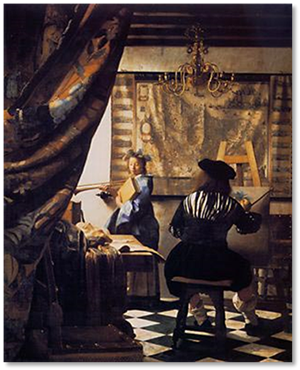
The Art of Painting by Johannes Vermeer
Image retrieved from http://goo.gl/CUIGnm
For educational purposes only.
To know more about paintings in the Baroque period, watch the following video:
KHANACADEMY. (2016). Baroque and Rococo. [Video file]. Retrieved from https://www.khanacademy.org/humanities/art-history-basics/Art-1010/v/baroque-rococo-introduction
10.3 Sculpture
Gian Lorenzo Bernini was one of the most influential sculptors from the Baroque period. His sculptures are vivid, intense and all of their characters show strength and movement. Let’s talk about some of his sculptures.
Pluto and Proserpina (Rape of Persephone, 1622).
This sculpture represents the moment when the god Pluto takes Proserpina to the underworld. It depicts Pluto holding Proserpina while she tries to escape. It is an impressive, very detailed sculpture, 89 inches high. For example, Pluto is grabbing the leg of Proserpina and the spectator can look the way his hand is digging in her flesh. Proserpina’s hand is pushing Pluto’s head, and you can see his reaction. “Bernini creates erotic tension between Pluto and Proserpina by a combination of pose and gesture characteristic of Baroque style. Although Proserpina struggles against Pluto, she also turns toward him” (Schneider, 2007).
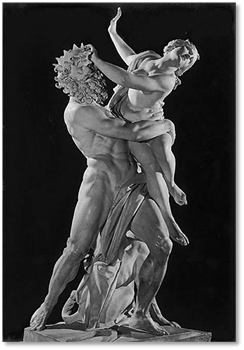
Pluto and Proserpina by Bernini.
Image retrieved fromhttp://goo.gl/kKmMO3
For educational purposes only.
David (1623).
There is another David’s sculpture, this time from the Baroque period. According to Khan Academy (2012), this sculpture “uses the space around it—reaching out into the space of the viewer. Bernini's David is not content—the way Michelangelo's is—to remain separated from us. [...] we immediately start to feel what David is feeling”. There is some kind of energy that allows us to understand and comprehend what is happening. Characters are not far from the spectator and they are not perfect, but dealing with real struggles. David is in tension, looking at the right moment to attack Goliath.
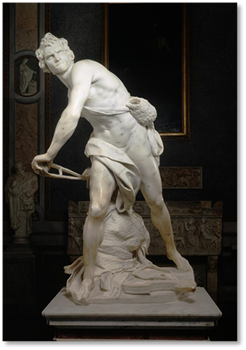
David by Bernini
Image retrieved from http://goo.gl/wN0i1W
For educational purposes only.
Ecstasy of St. Teresa (1647). A very intense sculpture where facial expressions and position of the characters are fundamental. It is located in the Cornaro Chapel, in Rome. The origin of this sculpture is a religious scene where Saint Teresa’s heart is inflicted with a sword, making Saint Teresa to achieve a spiritual moment of ecstasy. In the sculpture, the angel is carrying an arrow and Saint Teresa is depicted with her eyes closed, concentrated in their own spiritual moment. At the top of the sculpture there are some rays of light, like if God himself is illuminating the scene. “The combined effect is one of intense drama, the ethereality of which denies the true nature of the work of art. Despite being made of heavy marble, saint and angel—set upon a cloud—appear to float weightlessly” (Sullivan, 2014).
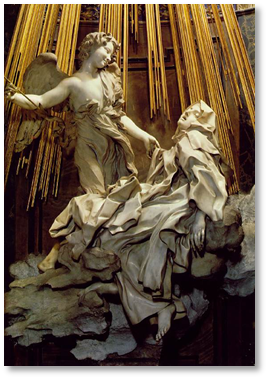
Ecstasy of St. Teresa by Bernini
Image retrieved from http://goo.gl/lqTT7M
For educational purposes only.
Conclusion:
The Baroque period, in all of its complexity and detailed way of being, is fascinating to look at. There are many different points of view that you can assume and, depending on your position, art would tell you a lot of things. I used the term “tell”, because artworks in this period are so fascinating that they seem to have a conversation with the spectator. That is what art should be about, a talk where everyone can say their thoughts and opinions.
Bibliographic references:
- Boston College. (2014). Caravaggio: Martyrdom of St. Peter. Retrieved from http://www.bc.edu/bc_org/avp/cas/his/CoreArt/art/bar_cvggo_peter.html
- Buffalo Architecture and History. (2002). Exterior - St. Peter’s Basilica. Retrieved from http://buffaloah.com/a/virtual/italy/rome/stpeter/ext/
- Encyclopaedia Britannica. (2014). Tenebrism. Retrieved from http://global.britannica.com/EBchecked/topic/587198/tenebrism
- Fernández-Madrid, M. T., et al. (2009). Historia del arte 2. Madrid: McGraw Hill.
- Jackson, J. (2014). The Reformation and Counter-Reformation. Johnson County Community College. Retrieved from http://staff.jccc.edu/jjackson/reformation.htm
- Khan Academy. (2012). Bernini’s David. Retrieved from http://smarthistory.khanacademy.org/Bernini-David.html
- McKay, B. and K. (2010). The Basics of Art: The Baroque Period. Art of Manliness. Retrieved from http://goo.gl/rTI0EV
- National Gallery of Art. (2014). Johannes Vermeer. The Art of Painting. Retrieved from http://www.nga.gov/exhibitions/verm_3.htm
- Norwich, J. J. (2013). Piazza of St. Peter’s. Great Buildings. Retrieved from http://www.greatbuildings.com/buildings/Piazza_of_St._Peters.html
- Rivera, N. (2014). Velázquez’s Las Meninas. Loyola University Maryland. Retrieved from http://evergreen.loyola.edu/brnygren/www/Honors/velazquez.htm
- Schneider, L. (2007). Art Across Time. New York: McGraw Hill.
- Sullivan, E. J. (1994). Baroque. Universitetet i Bergen. Retrieved from http://www.uib.no/ped/baroque.html
- Sullivan, E. J. (2014). The Ecstasy of St. Teresa. Annenberg Learner. Retrieved from http://www.learner.org/courses/globalart/work/98/
- The Saylor Foundation. (2014). Francesco Borromini and His Architecture. Retrieved from http://goo.gl/YmpLtl
- Visita Torino. (2013). Palazzo Carignano. Retrieved from http://www.visitatorino.com/en/palazzo_carignano.htm

Checkpoint
Make sure you understand:
- The characteristics of the Baroque period.
- The characteristics of Bernini’s sculptures.